

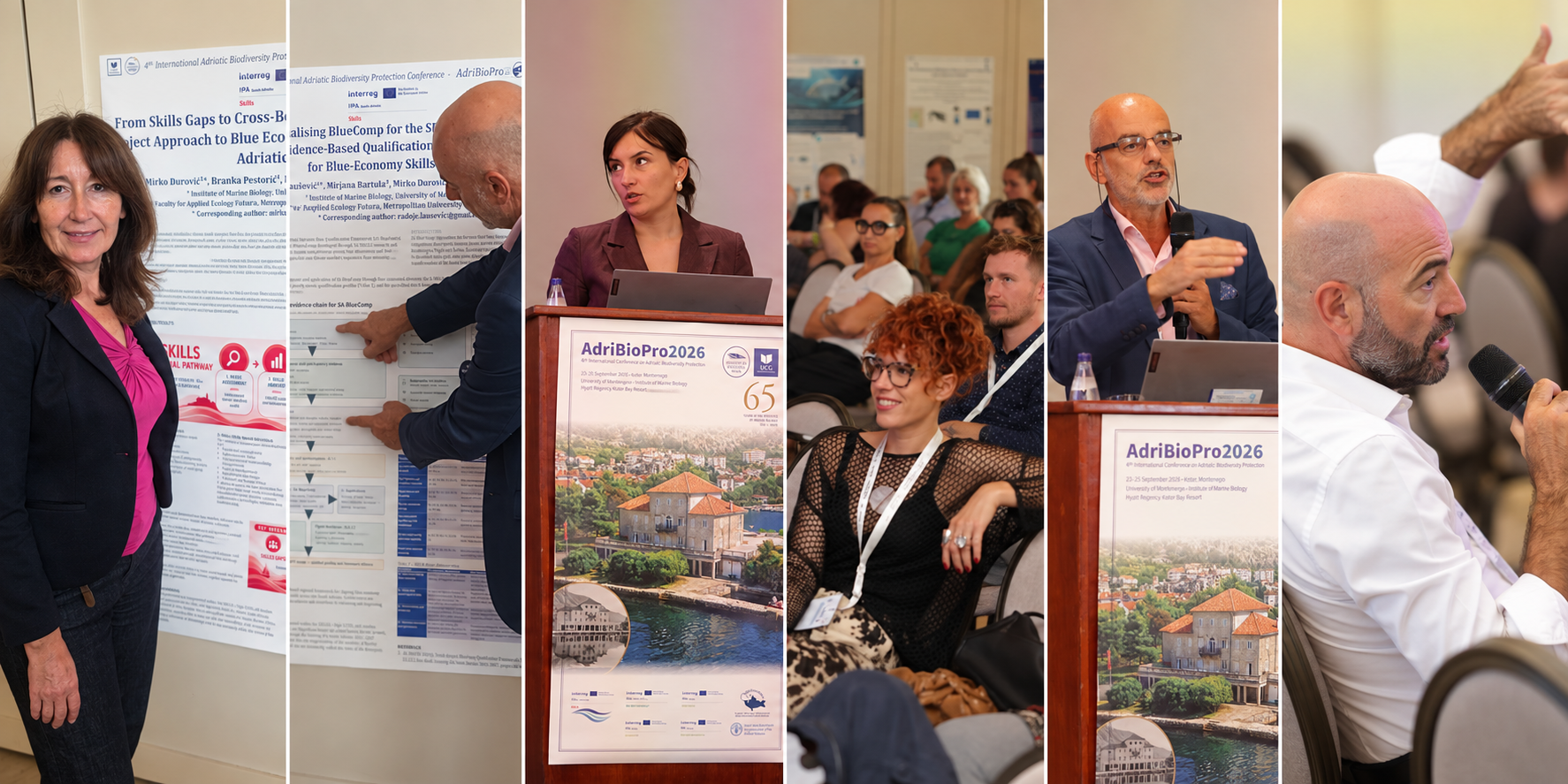
The SA SKILLS project presented a coherent set of project results and deliverables at AdriBioPro2026, within the conference theme T5 – Education, Communication, and Public Awareness.
The contributions covered the full SA SKILLS intervention logic: from identifying labour-market and competence gaps, through the development of cross-border learning and qualification instruments, to the digital infrastructure supporting long-term cooperation among education providers, companies, public authorities, research institutions and other blue economy stakeholders.
Together, the four presentations provided a scientific and practice-oriented overview of how SA SKILLS is contributing to a more coordinated, labour-market-responsive and future-oriented blue skills ecosystem in the South Adriatic.
1. From Skills Gaps to Cross-Border Learning: The SKILLS Project Approach to Blue Economy Education in the South Adriatic
Type of presentation: POSTER
Authors: Mirko Đurović, Branka Pestorić, Radoje Laušević, Mirjana Bartula
The poster presented the overall SKILLS educational pathway, showing how evidence on labour-market needs and skills mismatches is translated into education and training responses.
The approach starts with Skills Definition Labs, stakeholder consultations, a harmonised survey and cross-border analysis of emerging labour-market needs. The evidence highlighted common demand for technical competences, digitalisation skills, environmental sustainability competences, project management, regulatory knowledge and practical work experience, together with growing demand for hybrid professional profiles combining marine sciences, information technologies, tourism and sustainability.
Based on this evidence, SA SKILLS develops and tests Higher Education Learning Modules, work-based and blended learning, targeted upskilling and reskilling, digital access to educational content, and stronger industry–education cooperation. Practical implementation is supported by the Blue Economy Training Centre and the Adriatic Blue Growth Cluster Digital Platform.
The principal outcome presented through the poster was the six-step educational pathway:
Needs assessment → Skills analysis → Curriculum development → Testing and practical learning → Digital support and networking → Long-term uptake.
The contribution demonstrated how market evidence can be converted into flexible cross-border learning solutions that improve workforce preparedness, strengthen knowledge transfer and facilitate the recognition and circulation of blue economy competences.
2. Regionalising BlueComp for the South Adriatic: An Evidence-Based Qualification Framework for Blue-Economy Skills
Type of presentation: POSTER
Authors: Radoje Laušević, Mirjana Bartula, Mirko Đurović, Branka Pestorić
The second poster presented the draft South Adriatic Blue Qualification Framework – SA BlueComp, developed as a regional application of the European BlueComp approach for Albania, Montenegro, Puglia and Molise.
SA BlueComp is based on an evidence chain combining company and industry needs, skills bottlenecks, emerging professions and employment chains, four-helix stakeholder mapping, engagement sessions and Skills Definition Labs. The framework organises 15 competences into four dimensions:
understanding the blue economy;
digital and technological skills;
sustainability and resilience;
business innovation and governance.
A five-level mastery scale describes progression from foundational awareness to expert performance.
The poster also presented seven priority sector qualification profiles covering coastal and marine tourism, port logistics and maritime transport, aquaculture and fisheries, marine renewable energy, environmental monitoring and restoration, marine engineering and smart systems, and ocean data and blue research.
A practical demonstration was provided through the accredited HELM Kotor – Sustainable Development of the Yachting and Cruise Industry, showing how BlueComp competences can be connected to an ECTS-bearing cross-border programme combining theory, simulation, field visits and marine-laboratory experience.
The main outcome is a draft common regional competence language intended to support greater transparency, comparability and labour-market relevance of blue economy qualifications while respecting national qualification systems. Stakeholders were invited to contribute to its further validation through public consultation.
3. Bridging Blue Economy Skills Gaps in the South Adriatic: Comparative Evidence from Montenegro, Albania and Italy
Type of presentation: ORAL
Authors: Ivana Ognjanović, Radoje Laušević, Mirjana Bartula, Mirko Đurović
This oral presentation focused on the comparative evidence underpinning the SA SKILLS response to blue economy skills gaps.
The analysis was based on eight Skills Definition Labs and a harmonised multilingual survey involving companies, institutions and other blue economy stakeholders. It examined training demand, retraining needs, relevance of existing education programmes, critical skills for the next 5–10 years, and organisational preparedness for future sector requirements.
The results showed a broad regional demand for additional training and reskilling, while also revealing differences between countries and sectors. Montenegro reported comparatively stronger assessments of education provision in shipbuilding, ship repair and maritime transport, while Albania recorded higher evaluations in marine living resources. Environmental management emerged as a particularly important future competence in Albania, while project management, innovation and research and development showed similar relevance in Montenegro and Italy.
Across the three countries, a common gap remained between formal education and practical experience, emerging technologies and industry needs.
The study therefore supports the development of joint curricula, blended and work-based learning, targeted reskilling schemes and stronger cooperation among education providers, companies and public authorities.
4. From Blue Skills to Blue Growth: The Adriatic Blue Growth Cluster Digital Platform for Cross-Border Knowledge, Learning and Innovation
Type of presentation: ORAL
Authors: Radoje Laušević, Stefan Planić, Mirko Đurović, Mirjana Bartula
The fourth contribution presented the Adriatic Blue Growth Cluster Digital Platform as the digital infrastructure supporting long-term cross-border cooperation, knowledge exchange, education and innovation.
The platform responds to fragmentation among universities, research institutions, public authorities, businesses, civil society, professionals and learners by creating a shared digital environment for continuous cross-border interaction.
The platform integrates four modules:
eCommunication – professional profiles, networking, messaging, news and events;
eDocuments – searchable repository for project outputs and knowledge resources;
eLearning – courses, lessons, assessments and collaborative learning;
eCommerce – visibility for SMEs, products, services and cooperation opportunities.
The presentation showed that the platform had already moved from technical development to practical use. It supported the HELM Kotor Summer School, including student onboarding, course access, forums, assessments and 53 lessons, and is intended to serve as the digital backbone for the cross-border First-Level Master and other future learning pathways.
Its main outcome is the transition from isolated project activities towards a connected, reusable and sustainable blue economy ecosystem, providing one entry point for knowledge, learning opportunities, stakeholder profiles, networking, SME visibility and future cooperation.
One integrated SA SKILLS pathway
Taken together, the AdriBioPro2026 contributions illustrated a coherent progression:
Skills evidence → qualification framework → learning solutions → practical training → digital cooperation → long-term uptake
The comparative skills analysis provides the evidence base. The SKILLS educational pathway translates that evidence into learning responses. SA BlueComp provides a common framework for describing and comparing competences and qualifications. The Adriatic Blue Growth Cluster Digital Platform provides the digital environment through which knowledge, learning and cooperation can continue across borders.
The overall message presented at AdriBioPro2026 was that the South Adriatic blue economy requires more than individual training courses or isolated project actions. It requires an interconnected system linking labour-market evidence, competence development, education, practical learning, digital collaboration and cross-border recognition.
References
Đurović, M., Pestorić, B., Laušević, R., & Bartula, M. From Skills Gaps to Cross-Border Learning: The SKILLS Project Approach to Blue Economy Education in the South Adriatic. Poster presentation, AdriBioPro2026.
Laušević, R., Bartula, M., Đurović, M., & Pestorić, B. Regionalising BlueComp for the South Adriatic: An Evidence-Based Qualification Framework for Blue-Economy Skills. Poster presentation, AdriBioPro2026.
Ognjanović, I., Laušević, R., Bartula, M., & Đurović, M. Bridging Blue Economy Skills Gaps in the South Adriatic: Comparative Evidence from Montenegro, Albania and Italy. Oral presentation, AdriBioPro2026.
Laušević, R., Planić, S., Đurović, M., & Bartula, M. From Blue Skills to Blue Growth: The Adriatic Blue Growth Cluster Digital Platform for Cross-Border Knowledge, Learning and Innovation. Oral presentation, AdriBioPro2026.