

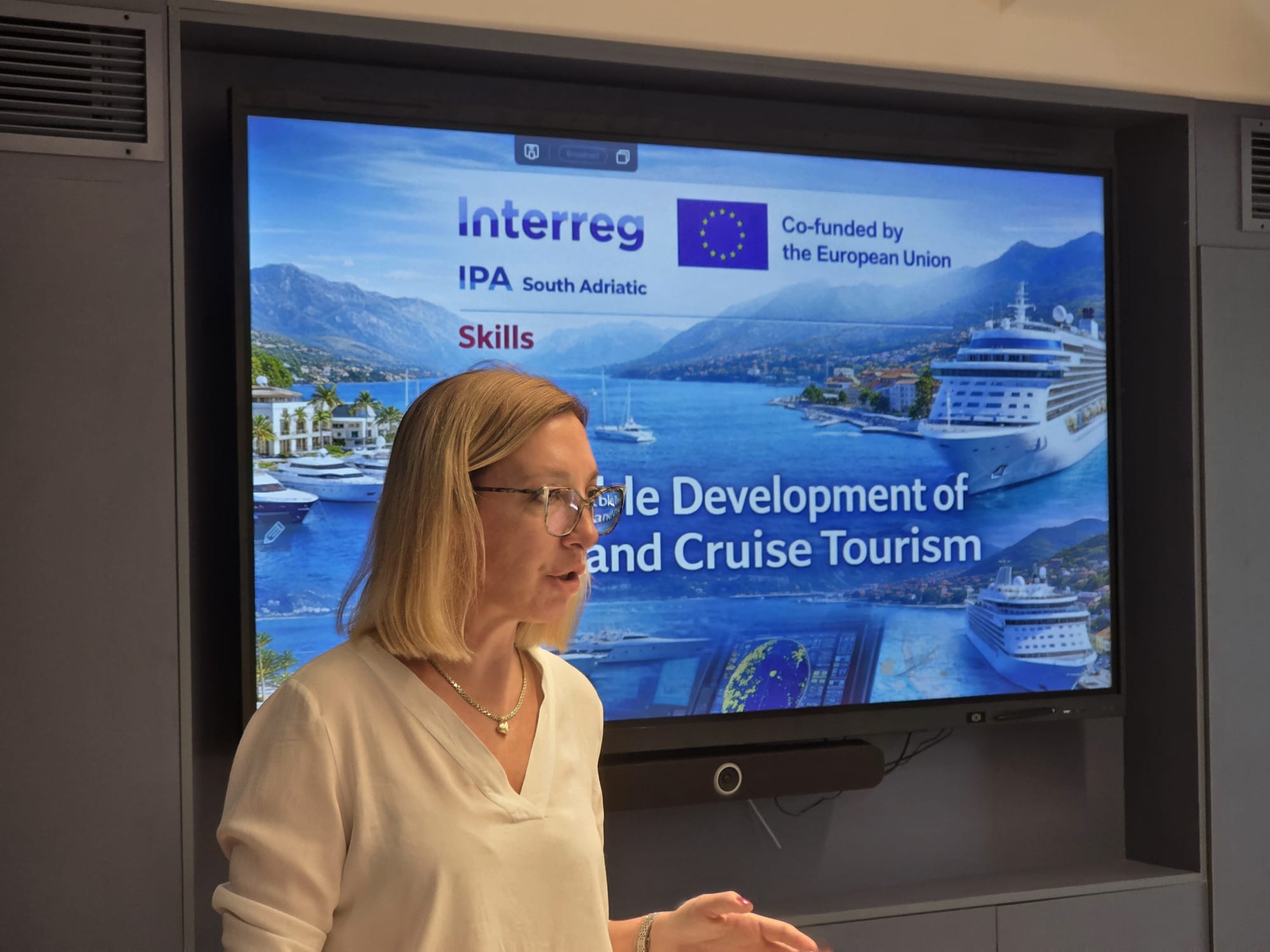
On Monday, 29 June 2026, the International Summer School “Sustainable Development of the Yachting and Cruise Industry” continued at the Blue Economy Training Centre (BETC) of the Institute of Marine Biology, University of Montenegro, with Thematic Module 1: Sustainable Development of Nautical and Cruising Tourism.
Lesson 1.3, titled “The connection between coastal and maritime tourism. Coastal and maritime tourism in the context of Blue Economy”, was delivered by Dr Milica Mandić, Scientific Advisor at the Institute of Marine Biology, University of Montenegro.
The lecture introduced participants to the Blue Economy as a framework that connects sustainable use of ocean and coastal resources with economic growth, job creation, marine ecosystem protection, climate change mitigation and adaptation, food security, innovation, and community well-being.
Special attention was given to the relationship between coastal and maritime tourism and their role in local development. The session highlighted the economic contributions of these sectors, including employment, local income generation, infrastructure development, support to local businesses, investment in coastal infrastructure, and public revenues through taxes and fees.
At the same time, participants discussed key environmental pressures linked to coastal and maritime tourism, including coastal erosion, marine pollution, overcrowding and overtourism, biodiversity loss, and climate change impacts. The lecture presented sustainable development strategies such as marine protected areas, sustainable marina management, green ports, circular economy practices, and responsible tourist behaviour.
The lesson also introduced aquaculture and mariculture as important components of the Blue Economy. Participants learned about different aquaculture systems, including extensive, semi-intensive and intensive aquaculture, integrated multi-trophic aquaculture, long-line and raft systems, and innovative multi-use approaches linking aquaculture with marine space planning, renewable energy, tourism, fishing, and scientific research.
A particularly practical part of the lecture focused on the tourism potential of mariculture and fisheries. Examples included guided boat tours to shellfish and finfish farms, hands-on harvesting, marine biology education, and dockside tastings of fresh, locally farmed oysters, mussels and fish.
Through this lesson, the HELM Kotor Summer School strengthened participants’ understanding of how sustainable tourism, maritime activities, aquaculture, environmental protection and local economic development can be connected within a modern Blue Economy approach.