

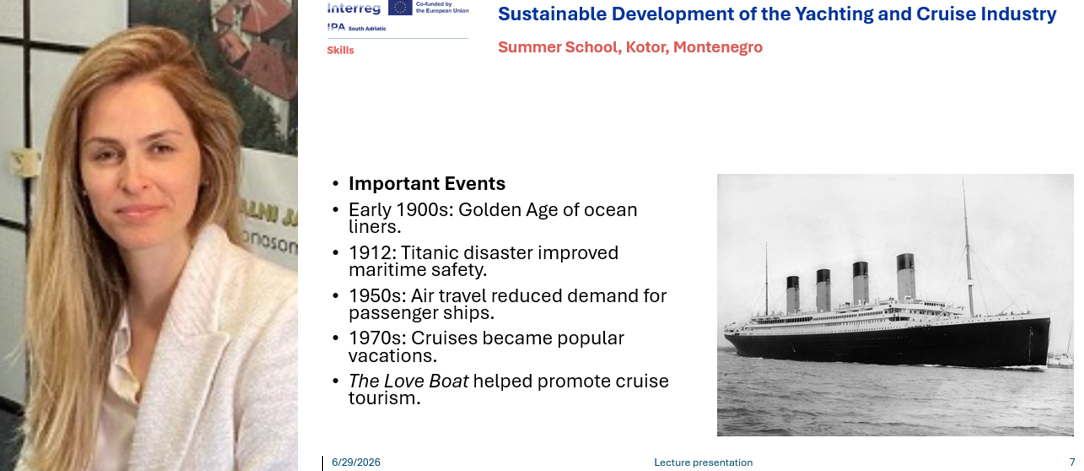
On Monday, 29 June 2026, the International Summer School “Sustainable Development of the Yachting and Cruise Industry” continued at the Blue Economy Training Centre (BETC) of the Institute of Marine Biology, University of Montenegro, with Thematic Module 1: Sustainable Development of Nautical and Cruising Tourism.
Lesson 1.1, titled “Introduction in nautical and cruising tourism”, was delivered by Dr Tena Božović from the Port of Kotor.
The lecture introduced participants to the concept of cruise tourism as a specific form of nautical tourism that combines maritime transport with hospitality, entertainment, cultural services and port infrastructure. Participants were introduced to the historical development of cruising, from early passenger and mail transport and the first purpose-built cruise ships to the modern cruise industry and today’s large floating resorts.
Dr Božović presented the main characteristics of the international cruise tourism market, including receptive and emission markets, the Mediterranean and North American markets, destination demand, passenger profiles, cruise tourism offer, and the role of ports, terminals, road connections, tourist attractions and business policies in attracting cruise companies.
Special attention was given to current trends shaping the sector, including younger and more diverse passenger groups, repeat travel, specialised offers, green cruises, new technologies on cruise ships, the growth of mega cruise ships, green ports, and the expansion of ports of call involved in cruise tourism.
The lecture also addressed the new concept of sustainable development of cruising tourism. Participants discussed the importance of analysing the macro and micro environment of destinations, conducting SWOT analysis of internal resources, and organising cruise destinations through economic, environmental and social sustainability measures.
A dedicated part of the session focused on the reached level of cruise tourism development in the Montenegrin coastal region, with particular reference to the Port of Kotor. Topics included natural, social and economic resources, cruise traffic indicators, passenger demand, destination activities, qualitative indicators of port operations, total consumption, and the social and environmental impacts of cruise tourism on the destination.
The session concluded with a clear message that the future development of cruising tourism should be based on innovation, quality improvement, strategic planning and stronger awareness of the importance and profitability of this form of selective tourism, while ensuring that growth remains aligned with sustainability principles.
Through this introductory lesson, the HELM Kotor Summer School provided participants with a strong foundation for understanding nautical and cruise tourism as a dynamic sector of the Blue Economy and as an important development opportunity for coastal destinations such as Kotor and the wider South Adriatic region.