

On Friday, July 3, 2026, the International Summer School “Sustainable Development of the Yachting and Cruise Industry” continued with advanced lectures within Thematic Module 6: Smart and Digital Marinas and Cruising Ports.
Organised within the Interreg IPA South Adriatic project “High LEVEL and market-respondent competences for a blue and digitalized ‘Smart and skilled South Adriatic’ - SKILLS”, the session was delivered by Miodrag Zarubica from the Faculty of Electrical Engineering, University of Montenegro.
The lecture covered four interconnected lessons: Lesson 6.4 “Cyber security in smart marinas and ports”, Lesson 6.5 “Digital twins and smart control boards for marinas and ports”, Lesson 6.6 “Application AI and remote observations in protect marine ecosystem”, and Lesson 6.7 “Blockchain in Maritime Logistics and Tracking”.
Participants were introduced to the concept of smart and digital marinas and ports as interconnected systems where infrastructure, vessels, equipment, users, data and decision-making tools work together. The session highlighted that digital transformation can improve efficiency, sustainability, safety and user experience, but also creates new risks that must be properly managed.
A key part of the lecture focused on cyber security in smart maritime environments. Participants discussed how connected systems in marinas and ports, including information technologies, operational technologies, communication networks, cameras, access control systems and supply-chain interfaces, can become potential entry points for cyber threats. The lecture underlined that cyber security is not only a technical issue, but also an operational, safety, environmental and management priority.
The session also introduced digital twins as live virtual models of real ports, marinas, terminals or equipment. Participants learned how digital twins combine operational data, sensor information and simulations to support planning, maintenance, energy efficiency, risk assessment and real-time decision-making.
Smart control boards were presented as integrated dashboards that allow operators to monitor ship traffic, energy consumption, equipment status, weather conditions, environmental data, maintenance needs and security events from a single interface. The lecture emphasised that the value of such systems lies not in the volume of data displayed, but in their ability to support clear and timely decisions.
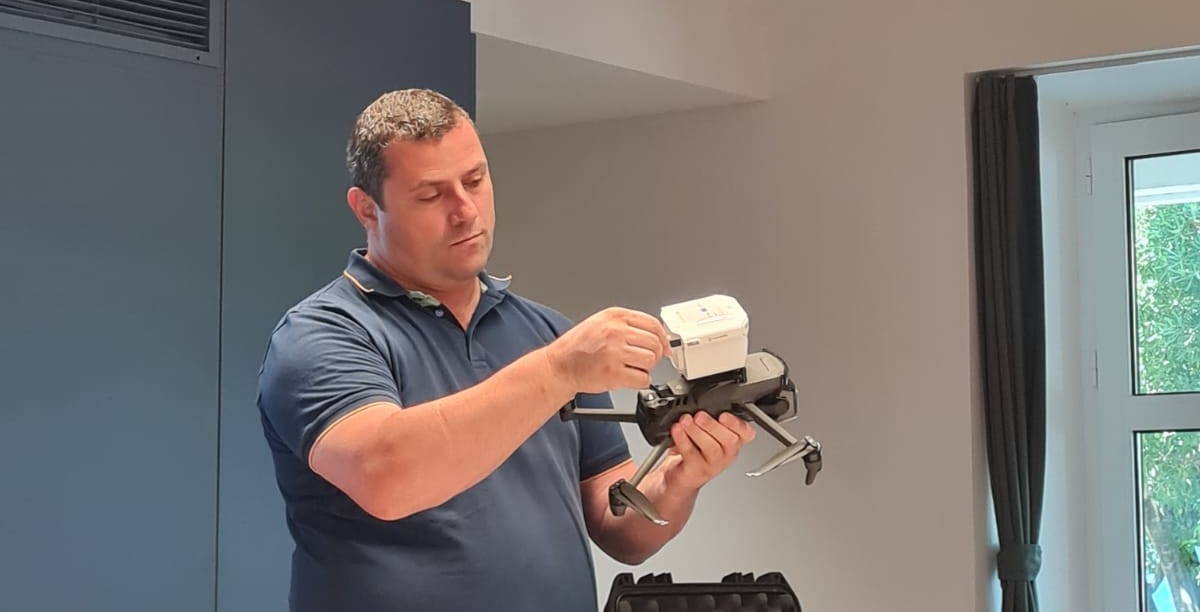
Special attention was given to the use of Artificial Intelligence and remote observation for marine ecosystem protection. Participants explored how satellite observation, drone inspection, buoys, underwater sensors and AI-powered cameras can support early detection of oil spills, floating waste, unusual vessel movements, changes in water clarity, temperature and algae levels. The importance of human expertise in validating and interpreting AI-supported findings was also underlined.
The final part of the lecture focused on blockchain in maritime logistics and tracking. Participants discussed how blockchain can support shared, traceable and tamper-resistant records for electronic shipping documents, cargo tracking, customs documentation and supply-chain event logging. At the same time, the lecture made clear that blockchain is not a standalone solution and that data quality, access control and reliable procedures remain essential.
Through this session, participants strengthened their understanding of how digital technologies are transforming marina and port operations, while also learning that successful digital transformation depends on secure systems, skilled personnel, reliable data and responsible decision-making.
By addressing smart technologies, cyber security, environmental monitoring and logistics transparency, the SKILLS project continues to support practical, cross-border education and the development of competencies for a smarter, greener and more sustainable South Adriatic Blue Economy.